Key Takeaways
- GEO (generative engine optimisation) is the work of getting your business recommended in AI answers — from ChatGPT, Google's AI Overviews, Gemini, Perplexity, and Copilot.
- Gartner predicts traditional search volume will drop 25% by 2026 as customers shift questions to AI chatbots — the enquiries don't disappear, they move.
- GEO doesn't replace SEO — it stands on it. AI tools build answers largely from existing search results and mentions of your business on trusted sites.
- Nobody can pay to be "ranked higher in AI." What works is a clear, credible, quotable website plus genuine mentions — the same fundamentals, on a new surface.
- You can check where you stand for free. A free AI Visibility Check shows whether AI tools mention your business today.
Generative engine optimisation — GEO — is the work of getting your business found in AI-generated answers, the way SEO gets you found in Google's search results. If a customer asks ChatGPT for "a good plumber near me" and your competitor is the recommendation, GEO is the reason why.
This guide explains what GEO is, why it's suddenly everywhere, how it differs from SEO, and the five practical steps that actually move the needle for a small business. We build and optimise small business websites for a living, and we'll also tell you the part most articles skip: whether you actually need this yet.
What Is Generative Engine Optimisation?
Generative engine optimisation is the practice of making your business visible in the answers written by generative AI tools — ChatGPT, Google's AI Overviews, Gemini, Perplexity, and Microsoft Copilot. Where a search engine gives the customer a list of links to click, a generative engine gives them a finished answer. GEO is how you earn a place in that answer.
The name is new, and you'll see the same idea sold under different labels: AI search optimisation, answer engine optimisation (AEO), LLM optimisation. They all describe the same shift. Customers increasingly ask a question and read one answer, rather than searching and comparing ten results — so businesses now compete to be in the answer, not just on the results page.
What GEO is not is a way to pay your way into ChatGPT. Nobody can reach inside an AI model and put your business at the top — anyone promising that is selling snake oil. What you can do is well understood: make your website the kind of source these tools find, trust, and quote. That's the whole discipline, and the rest of this guide covers how it works.
Why AI Answers Matter for Small Businesses
The behaviour shift is already measurable. ChatGPT alone reached around 800 million weekly users in late 2025 — and a growing share of those conversations are commercial questions: who to hire, what to buy, which local business to trust.
Gartner forecasts a quarter of search engine volume shifting to AI chatbots and virtual agents. The questions don't disappear — they move somewhere your website may be invisible.
"By 2026, traditional search engine volume will drop 25%, with search marketing losing market share to AI chatbots and other virtual agents."
— Gartner press release, February 2024
It's not just standalone chatbots. Google now places AI Overviews — an AI-written answer — above the traditional results for a growing share of searches, and Semrush's AI Overviews research shows they appear most often on exactly the kind of question-shaped, informational searches your customers make before they buy. Many of those customers read the answer at the top and never scroll to the links below it.
For a small business the maths is simple. If a meaningful slice of "who should I call?" questions now gets answered by AI, and the AI never mentions you, you've lost those enquiries without ever knowing they existed. The business that is mentioned gets them instead — that's the same winner-takes-most dynamic that made page one of Google valuable, playing out on a new surface while most local competitors aren't paying attention.
GEO vs SEO: What's the Difference?
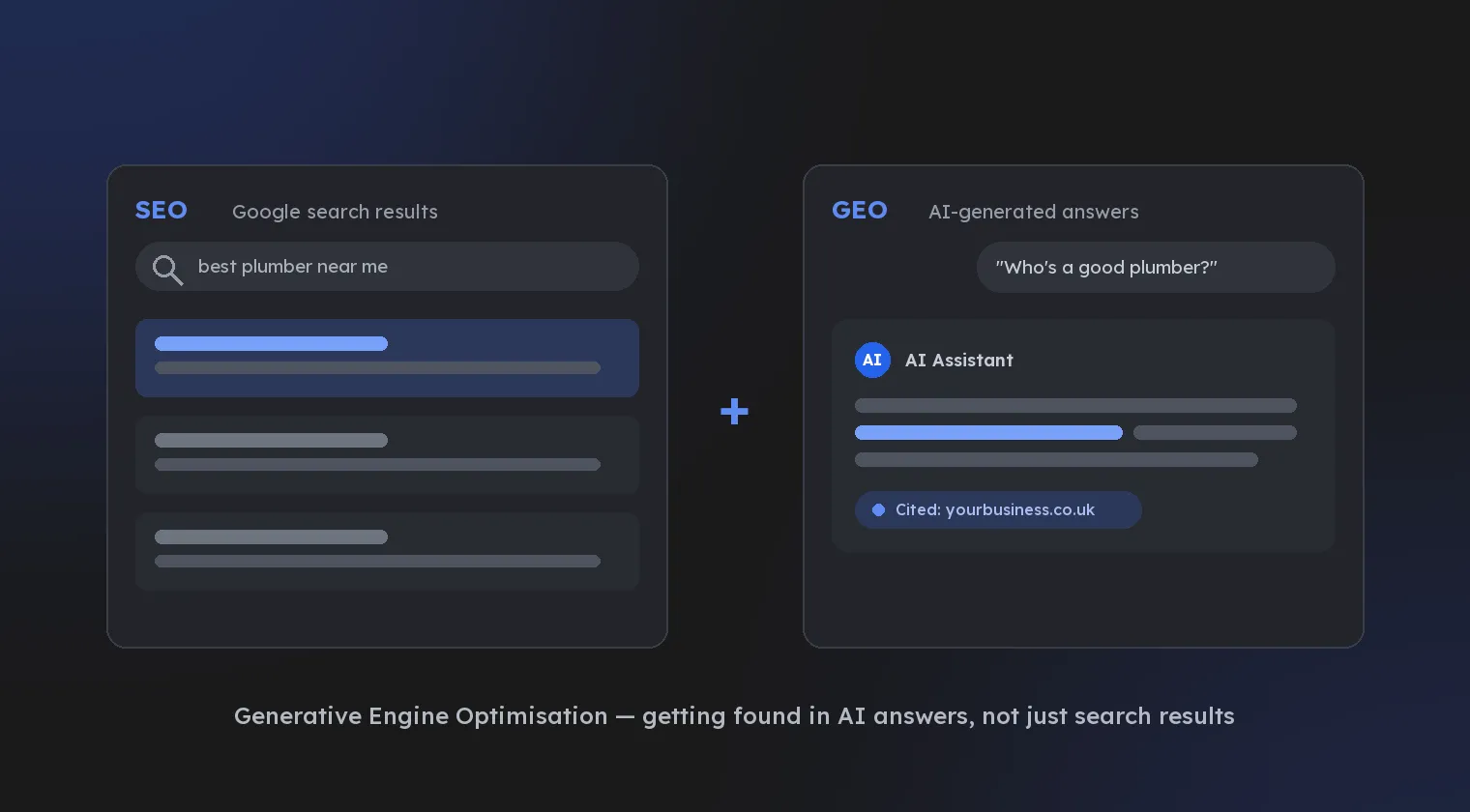
SEO gets you found in Google's list of search results. GEO gets you found in AI-written answers. The customer behaviour differs — searching and clicking versus asking and reading — but the work behind the scenes overlaps far more than most agencies selling "AI packages" will admit.
Search engine optimisation
You appear in Google's list of results. The customer searches, compares, and clicks through to your website.
Get found and clicked
Generative engine optimisation
You appear inside the AI's answer. The customer asks a question and reads a recommendation — often without clicking anything.
Get found and recommended
Here's the part that matters: the same fundamentals earn both. A fast, credible site, content that clearly answers real questions, and other trusted websites mentioning your business by name — that's what ranks on Google and what gets you cited by AI. Google's own guidance on AI features says as much: there's no special trick for appearing in AI Overviews beyond the standard work of being genuinely useful and technically sound.
That's why treating GEO as a separate product, bought separately, is usually a way to pay twice for one job. It's one piece of work with two surfaces — which is exactly how we deliver our own SEO & GEO service.
How AI Tools Decide Which Businesses to Recommend
AI assistants don't have opinions about your business. When someone asks for a recommendation, the tool typically runs a live search in the background, reads the sources it trusts, and composes an answer from what it finds. That means your visibility in AI answers is decided by a handful of concrete things:
Notice what's not on the list: tricks. There's no secret tag that makes ChatGPT like you. The tools are engineered to find the same signals of trustworthiness a careful human would look for — just faster and at scale.
How to Do GEO for a Small Business: 5 Practical Steps
1. Get the foundations right first
A slow, insecure, or confusing website undermines everything downstream — AI tools pull from the same crawlers Google uses, and they can't quote what they can't read. If your site is more than a few years old or was never built with search in mind, start there. (Our guide to web design for small businesses covers what a solid foundation looks like.)
2. Answer real questions on your pages
Write the questions your customers actually ask — "how much does X cost?", "do you cover my area?", "how long does it take?" — and answer them directly, in plain English, on your website. Question-and-answer content is the easiest thing for a generative engine to lift into an answer, and it's also what your human visitors want.
3. Add structured data
Schema markup labels your business type, services, prices, and location in a format machines read reliably. It's invisible to visitors, but it's the difference between an AI guessing what you do and knowing it. Most small business sites have none, so this is a genuine edge.
4. Get mentioned where it counts
AI tools weigh independent corroboration heavily. A complete Google Business Profile with genuine reviews, listings in the established directories, and mentions from local press or partner businesses all tell the machines — and your customers — that you're real and reputable. Build this honestly; bought links and fake reviews are exactly what these systems are trained to discount.
5. Track whether it's working
Ask the tools your customers use — ChatGPT, Gemini, Perplexity, Copilot — the questions they'd ask, and note whether you appear. Do it monthly and keep a record alongside your Google rankings. Visibility in AI answers shifts gradually, and you can't improve what you're not measuring.
Do You Actually Need GEO Yet?
Honestly: maybe not yet — and you should be suspicious of anyone who says otherwise without looking at your business first.
GEO is worth real attention if your customers research before they buy, if a typical enquiry is worth a meaningful amount, and if you want the early-mover advantage while most local competitors ignore this entirely. It's probably not your first priority if your website itself isn't solid yet, or if you're already turning away more work than you can handle.
Either way, the starting point is the same: find out where you stand. Generative engine optimisation starts with a simple question — when your customers ask AI for a recommendation, are you the answer? If you don't know, check before you spend a penny. We offer a free AI Visibility Check that shows exactly where you appear today — on Google and in AI answers — and which changes would make the biggest difference. No obligation, no jargon, and if the honest answer is "you don't need this yet," that's what we'll tell you.
Frequently Asked Questions
What does GEO stand for?
GEO stands for generative engine optimisation — the work of getting your business found and recommended in AI-generated answers from tools like ChatGPT, Google's AI Overviews, Gemini, Perplexity, and Copilot. It's sometimes also called AI search optimisation or answer engine optimisation (AEO).
Does GEO replace SEO?
No. AI tools build their answers largely from existing Google and Bing results plus mentions of your business on trusted websites, so strong SEO is the foundation GEO stands on. GEO extends SEO to a new surface — it doesn't replace it.
How long does GEO take to work?
Weeks to months, not days. Search rankings build gradually, and AI tools can take time to pick up changes to your site and new mentions of your business. Anyone promising overnight AI visibility is guessing.
How much do generative engine optimisation services cost?
Most agencies price GEO for large national brands, often £1,000+ per month on long contracts. Because the work overlaps so heavily with SEO, small businesses shouldn't pay for two separate services — combined SEO and GEO work is available from around £300 per month.